



All for one and one for all
The three neurological circuits that function like the three musketeers
If you apply the following, you will be a blessing sent from heaven for your patients with instability, clumsiness, or developmental problems.
It is an essential part of the course “Physiotherapy in the Cervico-Ocular Multisystem” with Lucila To and Iñaki Pastor, which will take place in April in Zaragoza.
Do you have patients with instability or dizziness?
You surely do. Children or adults.
This is especially a key topic in ADHD, autism, attention problems, and learning difficulties.
But also in traumatic brain injuries and neurological diseases.
Notice that instability is objective, it can be measured. But dizziness is subjective.
Children, for example, don’t generally experience dizziness; they have instability, except when there is a central or vestibular pathology.
Unless they had stability and then lost it.
In that case, they may present symptoms.
Postural control instability has a very clear correlation with an ocular parameter.
To build neurodevelopment, posture, and balance, a fundamental fact is required: the stability of visual fixation.
And in what situations?
Of course, the first is when we are still. That would be the first step. This is, when there is no head movement and the posture is secured.
The next step, and it’s a leap, is to achieve stability when the head is moving. This is where the situation becomes a challenge.
The next step is to maintain fixation stability when the head moves quickly.
And a third condition is required for full functioning: the stability of vision when the environment moves, like when people move in front of us in a shopping mall.
Well, these situations are secured thanks to three essential neurological circuits: (Figure 1)
- The Cervico-Ocular Reflex (COR)
- The Vestibulo-Ocular Reflex (VOR)
- The Nystagmus or Optokinetic Reflex (OKR)
Three systems like three musketeers. All for one (stabilization) and one for all.
Three systems you must always test…
Did I say always?
Yes, always when there is instability, clumsiness, falls, or dizziness…
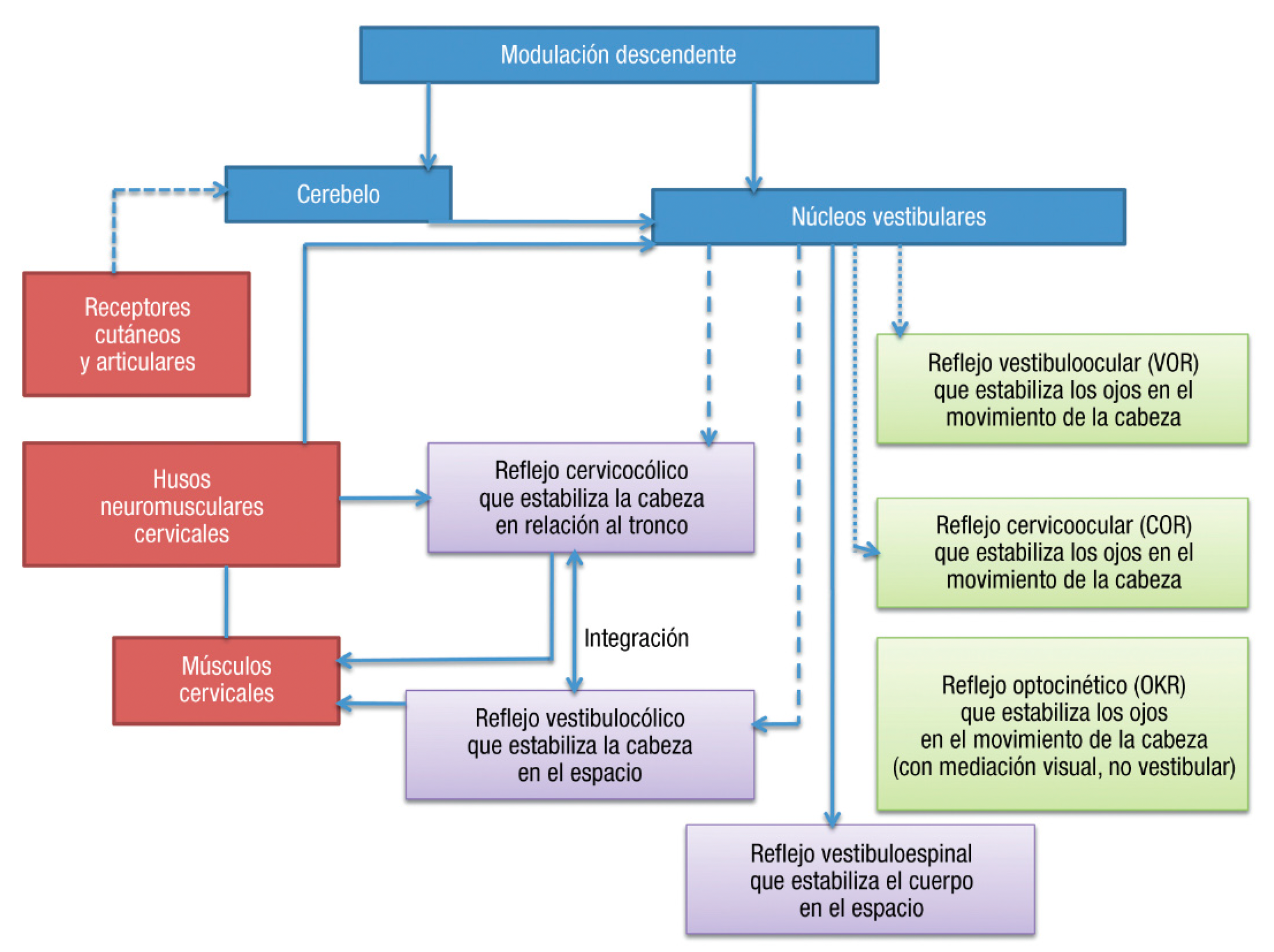
Figure 1. Different stabilization neurological circuits. Green for gaze stabilization circuits. Purple for cervical stabilization circuits. From the book “Manual Therapy in the Oculomotor System” 2nd Ed. Elsevier, 2019.
How to test them?
That’s another story.
The COR can be tested by having the patient look at a letter about 60 cm away while moving their head slowly in different directions. If the letter becomes blurry or distorted during any movement, the system fails.
The VOR can be tested with a dynamic visual acuity test. The patient is reading a text, and the clinician passively moves their head from behind and observes if the patient struggles to read. This test is very well described by Natalia Povedano in the recently published book “Neurodevelopmental Disorders” by Elsevier. A book we’ll present very soon. Truly a marvel.
The OKR can be tested with an optokinetic drum and a tablet app. Bars move in front of one eye in a specific direction. The quality of the nystagmus is observed.
If any of the systems fail, an intervention should be applied combining manual therapy on the oculomotor system and specific re-education exercises for these systems.
That is one of the strengths of the course:
“Physiotherapy in the Cervico-Ocular Multisystem”
With Lucila To and Iñaki Pastor.
Zaragoza, April 24-27.
Now you know!
If you can’t attend, then studying is up to you!
I’ve already left you several books to get you started.
Comments are closed.