


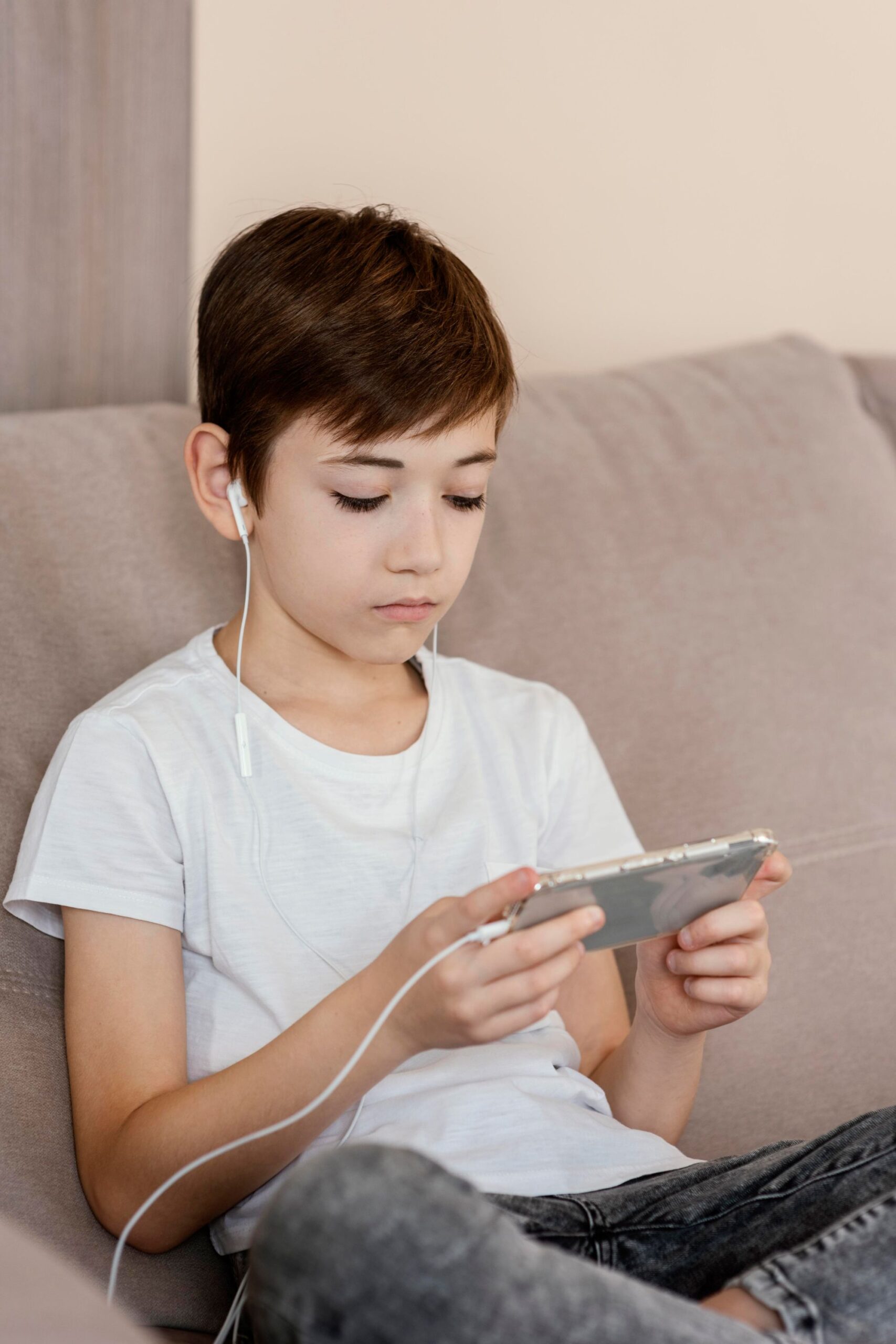
Let’s talk about this epidemic and how to prevent it
Yes, that’s right!
Not only do adults experience cervical pain
Cervical pain in children and adolescents is an evident and unfortunately growing issue.
Various studies are linking an increase in the incidence of neck and headache pain in children and adolescents to the use of mobile devices.
Neck pain is the 8th leading cause of disability in individuals between the ages of 15 and 19. Of course, it is more prevalent among adolescents with other pathologies, such as respiratory issues.
It’s possible that the relationship with mobile or cell phone use is greater than with computers or laptops, and this is related to neck position. Observe people at a bus stop or on the subway with their phone.
What position is the neck in?
In a strong forward flexion, with the phone close to the body. This creates significant mechanical stress on the neck, especially if maintained over time. In this situation, it is possible that an eccentric tension on the cervical muscles is irritating the attachments to the spine and skull. We could also think about an increase in neuro-meningeal tension. To reduce tension on the nerve roots, it would be normal to find the shoulders somewhat elevated.
The time aspect is also key. It is believed that many children and adolescents spend up to 4 hours daily using their devices. This means that the neck position multiplied by the time spent results in a pretty troublesome combination (a term from deep Spain).
There’s a hidden component.
What do you think it is?
It’s vision and oculomotor function. In this neck position, the eyes can’t move easily. Don’t forget that we have strong influences of cervical proprioception on oculomotor function (Campbell et al., 2023). This has been very clearly observed in people with whiplash (Bexander & Hodges, 2012).
This is why in TMPI, we always include oculomotor evaluation alongside cervical evaluation. Essentially, it’s not enough to treat the neck. This is the essence of the course “Physiotherapy in the Cervico-Ocular Multisystem” by Iñaki Pastor and Lucila To.
So, what do we do with all this?
Here are some key points:
- Never treat the neck without evaluating the cervical stress activities that might be involved.
- If you see cervical discomfort in children or adolescents, include questions in the evaluation about time and positions related to technology use. Have them show you how they are positioned. Pay attention! Consider mobile (cell phones), computers, video games, etc.
- Encourage the family to talk to their child and explain what intelligent technology use looks like, as well as the consequences this can have on their discomfort.
- Motivate families to set clear limits on technology use. Create spaces and times without phones… for EVERYONE at home. For example, no one should have their phone at the table during meals or breakfasts. If parents don’t get involved, it will be impossible for teenagers to adopt this.
- Work with the child or adolescent on improving ergonomics when using devices. For example, explain how more neck flexion is problematic and how simply raising the phone can help a lot. Reach agreements to limit screen time.
- And, of course, treat the neck and the oculomotor system. Not only with TMPI manual therapy but also with the exercises that Lucila teaches to integrate eyes and necks, to give them freedom and coordination.
I’ll leave you some references. Not too many, so as not to overwhelm you.
I’ll also leave a good YouTube video on vision and posture.
Safe journey!!
Iñaki Pastor
Bibliography
Text Neck Syndrome in Children and Adolescents.
David D, Giannini C, Chiarelli F, Mohn A. Int J Environ Res Public Health. 2021 Feb 7;18(4):1565. doi: 10.3390/ijerph18041565.Cervico-Ocular and Vestibulo-Ocular Reflexes in Subclinical Neck Pain and Healthy Individuals: A Cross-Sectional Study.
Campbell D, Murphy BA, Burkitt J, La Delfa N, Sanmugananthan P, Ambalavanar U, Yielder P. Brain Sci. 2023 Nov 18;13(11):1603. doi: 10.3390/brainsci13111603.Cervico-ocular coordination during neck rotation is distorted in people with whiplash-associated disorders.
Bexander CS, Hodges PW. Exp Brain Res. 2012 Mar;217(1):67-77. doi: 10.1007/s00221-011-2973-8. Epub 2011 Dec 17.
Comments are closed.