


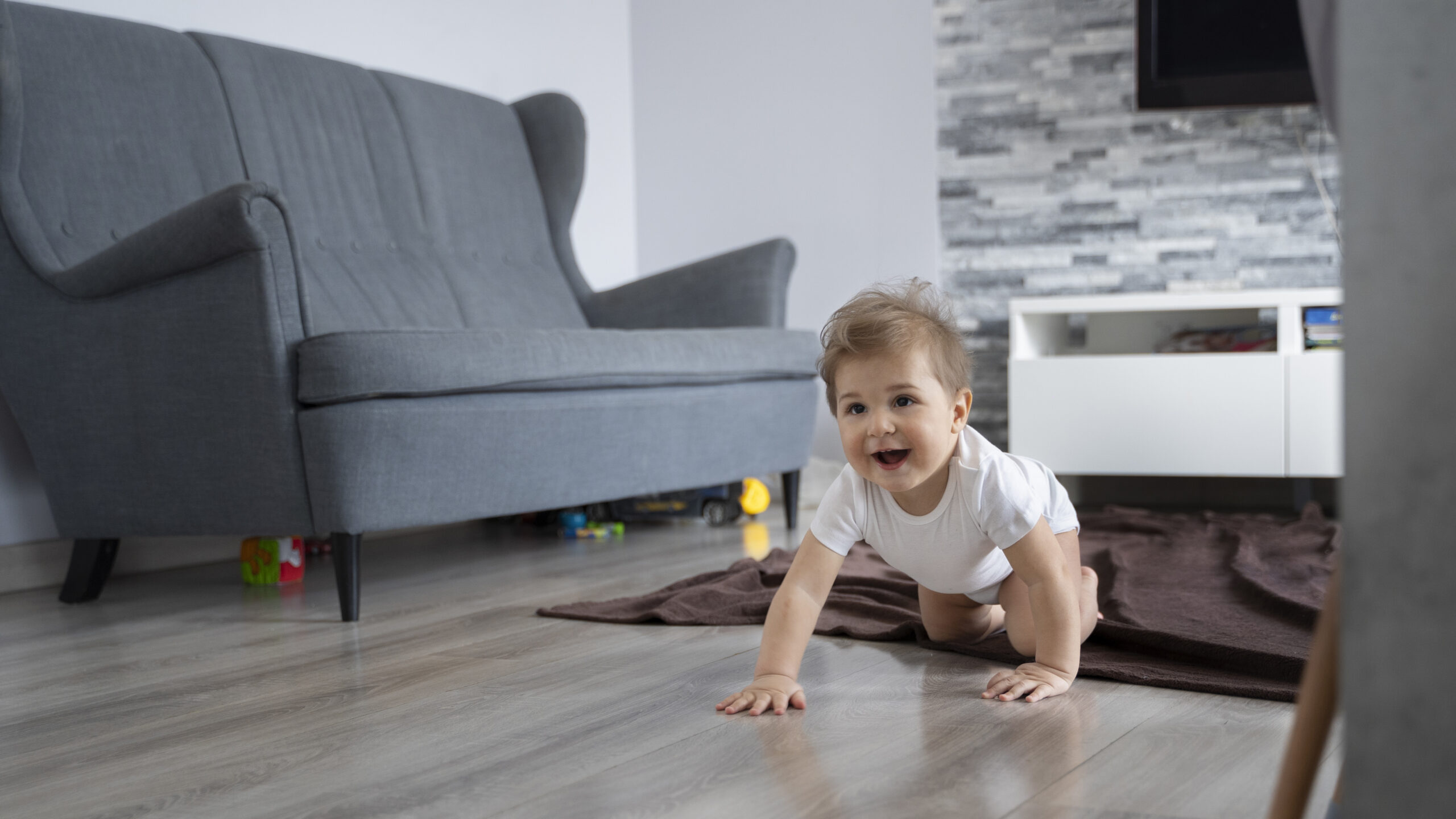
In clinical practice, it is common to see babies who crawl in “different” ways: with one foot turned outward, in a semi-sitting position, or using patterns that differ from classic quadruped crawling.
So the question arises:
Is it normal? Is there an ideal way to crawl? Is it really important?
Crawling usually appears around 9–10 months, although some babies do it earlier, others later, and some do not crawl at all. Even so, we now know more and more that this stage can contribute greatly to infant development.
What are the benefits of crawling?
- Motor development
Some recent studies suggest that when crawling (or walking) is delayed by at least one month, this could increase the risk of later difficulties in motor coordination.
This does not mean that a baby who does not crawl will necessarily have a problem, but it does mean that the quality and timing of crawling can give us valuable information about how the motor system is being organised. - Socio-emotional development
It has been observed that babies who crawl show a greater ability to recognise changes in their caregivers’ facial expressions (for example, from a relaxed face to an alert one).
Exploration involves small challenging situations, and this trains the baby in emotional reading and social connection. - Language and cognition
It has also been described that babies who crawl recognise vocabulary related to actions and movement more effectively.
Motor experience does not only build coordination: it also contributes to spatial orientation, the relationship with the environment, and cognitive development.
Is there an ideal way to crawl?
The classic pattern is quadruped crawling with coordinated alternating arm and leg movements. However, there is great variability within typical development.
That said, recent studies indicate that the quality of crawling (stability, coordination, organisation of support points) can provide relevant information about motor development.
In other words, it is not only about moving from one place to another, but about how this is done.
That is why crawling can be part of observation and early detection opportunities in neurodevelopment.
Can we support good crawling?
Yes, and in a simple way:
▪️ More tummy time from the very first days (always while awake and supervised).
▪️ Carrying and contact in gradually upright positions, supporting the vestibular system and postural stability.
▪️ A safe floor space for free exploration.
▪️ Adults on the floor, playing and engaging at the baby’s level.
▪️ Avoid rushing to place the baby in standing and do not use baby walkers.
Many babies with excellent development, even when they are already pulling to stand, still prefer quadruped crawling because it is more efficient for exploration.
In conclusion
Crawling is not just another stage.
It is an experience that integrates movement, emotion, cognition, and the relationship with the environment.
Observing how a baby crawls allows us to better understand their development and, if necessary, intervene early together with the family.
Because in infant development, every movement counts.
This article is once again based on a video from Iñaki’s new YouTube channel.
If you would like to explore the topic further and watch the full video, you can do so here:
https://www.youtube.com/watch?v=bZBBXnJE3Zc
Comments are closed.