


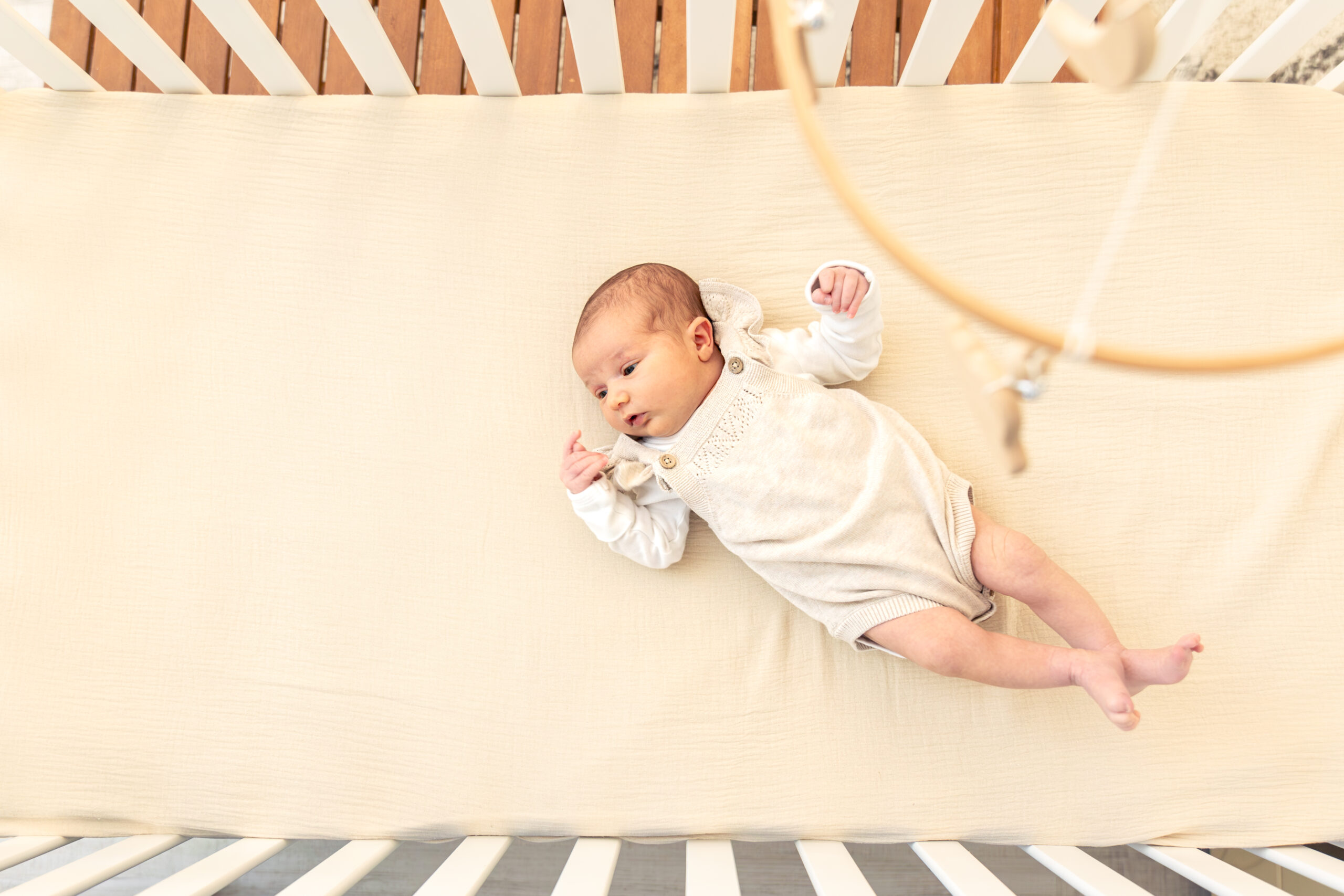
One of the biggest concerns for families in the early months of life is, undoubtedly, sudden infant death. The feared situation where the baby is sleeping and never wakes up again.
This is why, since 1994, following the recommendation of the American Academy of Pediatrics, it has been advised that babies sleep on their backs. The impact was decisive: in just two years, the incidence of sudden death decreased by approximately 50%.
However, this recommendation brought about another phenomenon: an increase in
cranial flattening and postural deformities. Thus, the big question arises:
Is it really dangerous to sleep on the stomach?
Or does it depend on the timing and conditions?
As pediatric physiotherapists, we need to understand the balance between safety during sleep and proper stimulation during wakefulness.
What babies are at greater risk?
1️⃣ Age
The risk increases especially until 4 months. During this period, the respiratory system is immature, and the ability to exit deep sleep is limited.
Sleeping on the back promotes a lighter sleep and facilitates waking up in the face of an adverse situation.
2️⃣ Physiological Fragility
Some babies are more vulnerable:
▪️ Premature babies
▪️ Babies with brainstem disorders
▪️ Cardiopathies
▪️ Genetic disorders
▪️ Ion channel problems (nerve conductivity)
In the case of premature babies, cardiorespiratory fragility and difficulty transitioning between sleep stages make preventive measures even more stringent.
Key prevention factors
Let’s examine the main modifiable factors.
- Bed-sharing
Bed-sharing can facilitate breastfeeding and comfort but increases the risk when:
▪️ Any parent smokes
▪️ Has consumed alcohol
▪️ Takes medications that depress the nervous system
▪️ The surface is soft (sofas, mattresses that sink) - Bedding
Avoid:
▪️ Thick comforters
▪️ Soft blankets under the baby
▪️ Cushions, wedges, or pillows
Important Recommendations:
▪️ The baby should be placed with their feet touching the bottom of the crib to avoid sliding.
▪️ Blankets should cover, but not go underneath.
▪️ A sleep sack is recommended, which reduces the risk of the head being covered. - Breastfeeding
Breastfeeding is a proven protective factor.|
Orofacial activation during sucking promotes lighter sleep and facilitates waking in response to adverse stimuli.
Similarly, the use of a pacifier until six months has also been associated with a protective effect.
- Ambient Temperature
Overheating is a risk factor.
▪️ The room should not exceed 18°C.
▪️ Avoid covering the baby’s head.
▪️ Pay special attention in winter, when homes are often too heated. - Inappropriate Sleeping Devices
Car seats are not safe spaces for prolonged sleep.
The baby remains with:
▪️ Closed shoulders
▪️ Compressed chest
▪️ Increased difficulty breathing
Rest should be done in a firm, safe crib.
So… is stomach sleeping bad?
Here comes the key point.
▪️ For sleeping: back sleeping (at least during the first 6 months).
▪️ For development: tummy time, awake and supervised.
Tummy time during wakefulness is essential.
Benefits of Tummy Time (when the baby is awake)
The evidence is clear: the more supervised time the baby spends on their stomach, the better the developmental outcomes.
✔ Better global motor development
Increased body control, better movement quality, and improved crawling.
✔ Better gastric emptying
In this position, the stomach empties more efficiently.
✔ Better lung ventilation
In studies with fragile and premature babies, ventilation improves in the prone position (always supervised).
✔ More opportunities for play and exploration
It is the natural position for:
▪️ Supporting on forearms
▪️ Freeing hands
▪️ Exploring the environment
▪️ Initiating movement
✔ Prevention of plagiocephaly
Reduces constant pressure on the back of the skull.
What does the research say?
A recent study compared:
▪️ A group with regular care
▪️ A group with more supervised tummy time
The results showed that:
▪️ There were no significant differences in head elevation.
▪️ But better motor and cognitive development was observed in the babies with more supervised tummy time.
This reinforces a fundamental message for our clinical practice.
Conclusion for families and professionals
The current evidence allows us to integrate both recommendations without contradiction:
✔ Sleeping on the back saves lives.
✔ Tummy time while awake enhances development.
As pediatric physiotherapists, our role is to educate, support, and provide clear tools to families so they can offer their babies:
▪️ A safe sleeping environment
▪️ A rich environment for development
Balance is the key.
🔎 This note is once again based on a video from Iñaki’s new YouTube channel.
If you want to explore the topic further and watch the full video, you can do so here:
👉 https://www.youtube.com/watch?v=LFG8zLRas3g&t=63s
And if the content brings you value, we invite you to subscribe to the channel so you don’t miss the upcoming videos.
Comments are closed.