


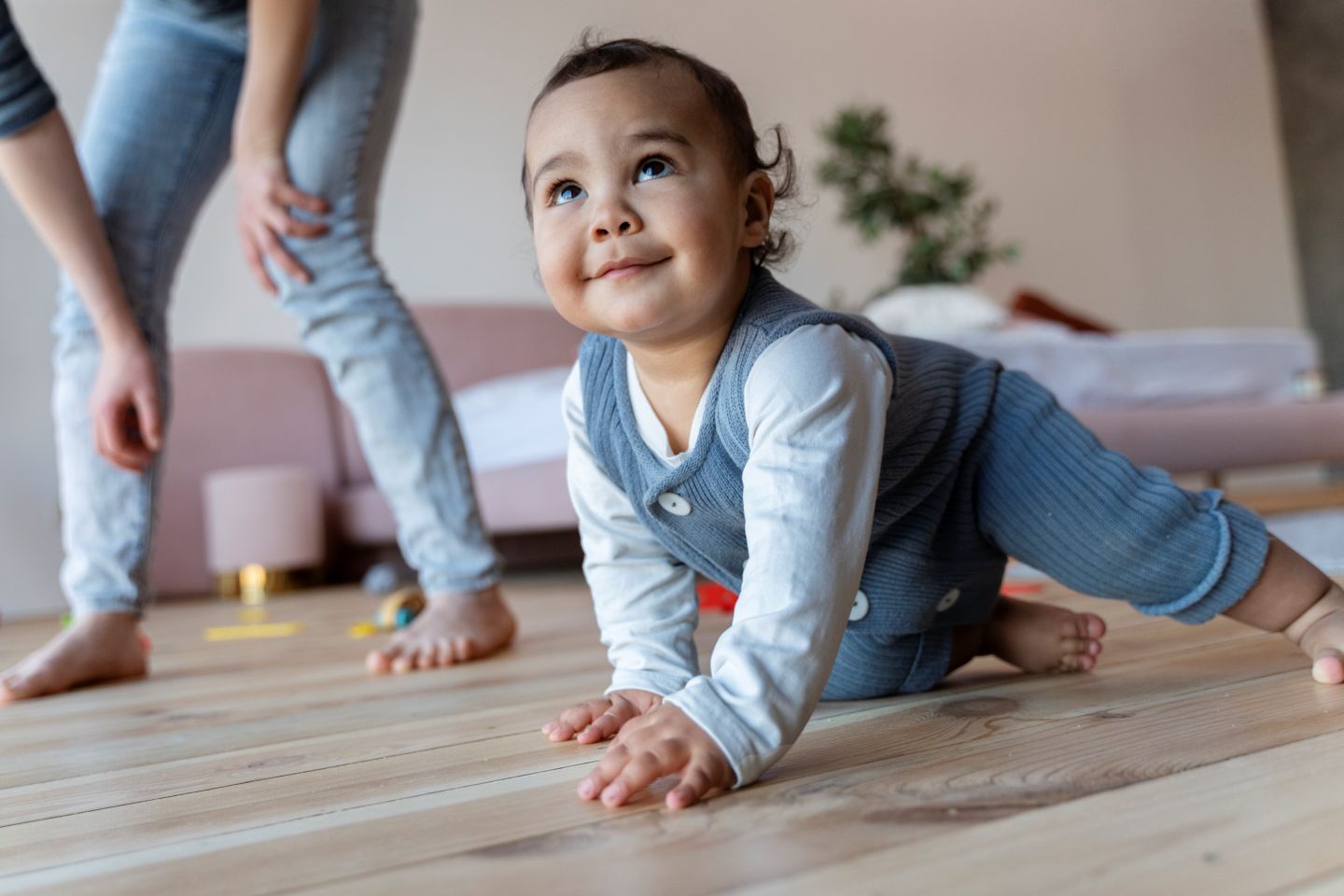
Many families consider crawling a secondary motor milestone. However, when a baby presents with an asymmetric crawling pattern, it is not a matter of “preference” or a mere curiosity, but a clinical indicator that deserves attention.
Crawling as the Result of Previous Stages
To achieve stable crawling, the baby must first:
- Sufficiently experience the prone position.
- Activate the abdominal core.
- Achieve full extension of the upper limbs.
- Develop dissociation between the scapular and pelvic girdles.
These competencies build the neuromusculoskeletal foundation that allows not only crawling, but also the progression toward standing and walking.
When the Absence of Crawling Is a Red Flag
It is true that in some cultures crawling does not occur due to environmental reasons. But outside of that context, absence or delay may indicate:
- Hypotonia.
- Cervical, thoracic, lumbar, or hip dysfunctions.
- Vestibular or visual deficits.
- Digestive discomforts that condition posture.
- Environmental or caregiving limitations.
The Meaning of Asymmetric Crawling
If the baby crawls but does so asymmetrically, it is necessary to observe:
- Tone asymmetries between hemibodies, related to cervical, lumbar, or pelvic dysfunctions.
- Restrictions in lumbar extension, which favor lumbopelvic flexion patterns.
- Relationship with recurrent gastrointestinal dysfunctions, which generate postural compensations.
Clinical Approach
Asymmetric crawling requires detailed evaluation to differentiate muscular, orthopedic, vestibular, visual, environmental, or visceral causes. Intervention includes:
- Somatic manual therapy in restrictive segments.
- Motor stimulation exercises (prone, dissociation, strengthening).
- Guidance for caregivers to encourage postures and stimuli.
- Continuous reassessment to ensure symmetrical progression.
Conclusion
Asymmetric crawling should not be interpreted as a variation of little importance. It is an early functional indicator that, when properly recognized, allows for early and effective action, ensuring a harmonious and integrated motor development.
Comments are closed.