


I’ll give you the solution at the end.
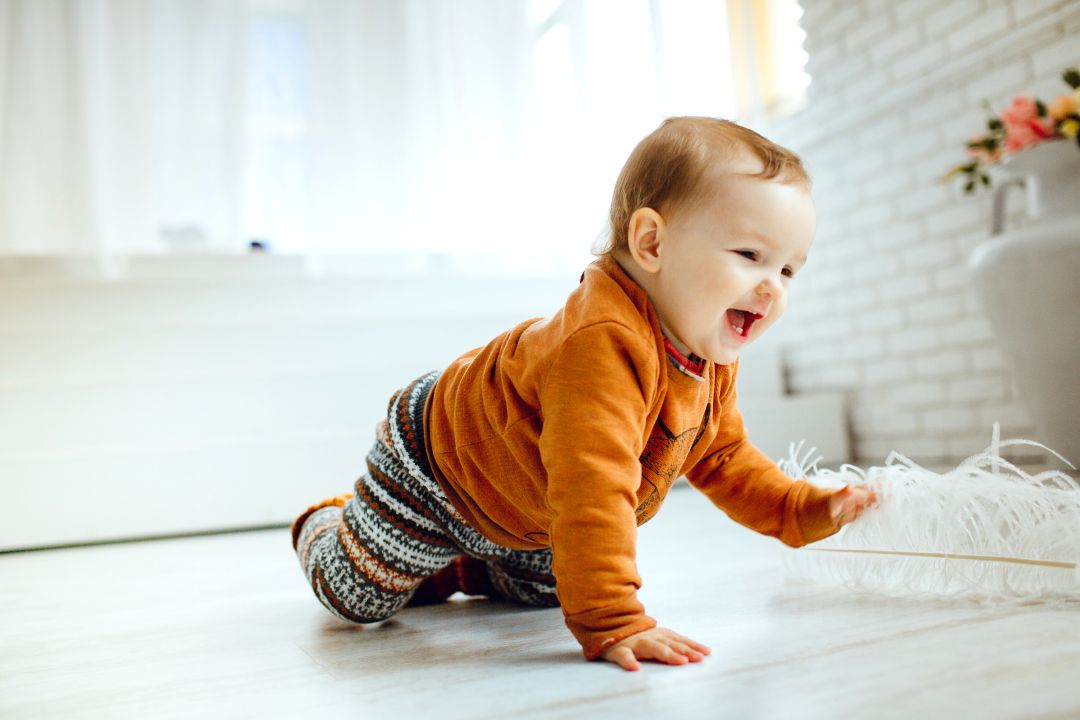
Crawling can be considered a motor milestone.
Dragging, on the other hand, isn’t so clear. To me, it’s not really a milestone. It’s more about being in prone with the intention of reaching something. But it’s not always a great sign. I actually prefer pivoting—rotating around the belly button in prone and coordinating contralateral patterns.
The Alberta Infant Motor Scale, one of the best tools for assessing infant motor and postural development, doesn’t analyze crawling in such depth.
But it’s still interesting.
There are several requirements for crawling:
- A stable quadruped position, which might emerge around 8–9 months
- Integrated contralateral patterns, essential for any kind of locomotion
- Motivation… I mean, a drive to conquer the world—okay, maybe that’s too much, but at least a desire to explore it
Crawling has shown benefits not just in motor development. Babies who crawl seem to demonstrate better integration between the visual and proprioceptive systems, as well as better spatial perception compared to those who don’t crawl.
You also have to consider the emotional benefit of separating from the mother to explore the world alone. That takes courage. The boldness to discover, to take risks on your own. To step away from safety—and then be able to come back.
The problem is, many babies crawl in odd ways. A common pattern is crawling with one leg in flexion and the foot on the ground. But there are other unusual patterns too.
Experts in child development often say: “It doesn’t matter how they crawl.” They’re thinking from a psychological perspective. What matters is that they explore and move. And I agree—that is important.
But it’s not the only thing that’s important. It would be ideal if they could do it with both knees on the ground and a nice contralateral pattern. Babies who start crawling earlier (I’m not saying too early—that’s up to the reader to decide) show more varied patterns. Meanwhile, those who crawl around 9–10 months tend to use a more uniform pattern.
When I see that flexed-leg crawling pattern, I consider several possibilities:
- A lumbar issue requiring lumbar kyphosis and asymmetry at the hips
- Lack of prone time prior to this stage. A plain and simple lack of prone experience before the crawling phase.
This last one is the most likely in many cases. Many babies are “abandoned” in sitting (flexion), and they’ve missed out on hundreds of hours of extension in prone. No wonder they end up crawling in flexion.
If you go through the Alberta scale, you’ll see these babies score a bit lower, and they lack variability in their movement patterns. That’s something important to evaluate across the scale.
Remember: This month the online motor development course from PIMT will be gone.
Solution to weird crawling?
Don’t try to “fix” their crawling. Crawling can’t be re-educated directly.
It simply doesn’t work.
Put the baby in prone with help from the family. Every day. But you’ll have to fight a bit—they’ll want to lift their pelvis, and you can’t let them. They’ll push up with their arms and get frustrated. That’ll put them into an extended posture similar to the 6-month pattern, even if they don’t like it.
Doing this at home every day, even for a short time, will bring loads of benefits—not just for crawling, but for their global neurodevelopment.
See you soon!
Comments are closed.