


This title may seem a little exaggerated. But if I told you that as early as 36 weeks of gestation, fetuses seem to respond to the maternal voice, or if I showed you that there are several indications in the literature that refer to an auditory learning of certain speech characteristics before birth; what would you think?
Newborns seem to recognise the maternal voice within hours of birth, showing some preference for it over other voices. (This feature has been glimpsed in different behaviours, such as more frequent sucking, slowing of heart rate and movements).
In fact one study claims that a fetal response to the maternal voice could be visualised at 36 weeks gestational age. (Voegtline KM, et al. 2013).
How can this ability be explained?
Fetuses are thought to be susceptible to sounds that they experience repeatedly.
Already at gestational age the fetus begins to react and respond to sound stimuli, in fact the maturation process of the auditory system begins at the prenatal stage, although it will continue until around the age of 20 years (Munar, E et al. 2002).
The first sounds experienced by the fetus are low-frequency ones, transmitted through the bones of the skull, by a liquid medium, the amniotic fluid. (Sohmer et al. 2001).
Imagine for a moment that you are in the womb, what do you think you would hear?
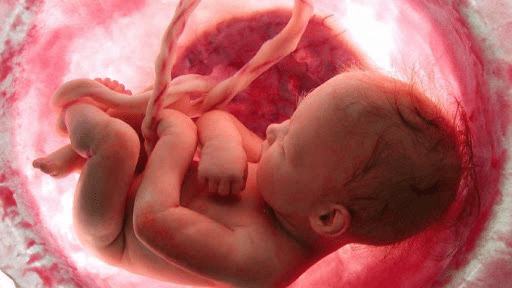
The prenatal environment is occupied by low frequencies, mostly from biological noises of the mother and fetus (pulsations of the vessels, digestive, respiratory and body movement noises, etc.), as well as the maternal voice AND sounds coming from outside the womb.
This environment of maternal tissues and fluids within the intrauterine cavity is a space of development and protection for hearing as well, providing an optimal environment for the early stages of hearing development by limiting exposure to high frequency sounds, for which the fetal ear is not yet sufficiently mature.
It even reduces the high-frequency components of externally sourced speech sounds, while preserving their prosodic characteristics (Munar, E et al. 2002).
As birth approaches, this attenuation capacity decreases and sound stimuli from the extrauterine world become increasingly responsive, until from 37-41 weeks of intrauterine life fetuses react to various naturalistic sounds with a wide frequency spectrum. (Moore, et al. 2001) (Lava A and Skoe E. 2014), indicating an increase in sensitivity of the fetal auditory system with age.
As we have seen, the human intrauterine environment provides a rich environment for auditory stimuli. However, the maternal voice occupies a prominent place, being less attenuated than those voices of external origin, as it is accompanied by internal vibrations of the maternal larynx and diaphragm.
This complexity of sound helps in the exercise of discerning the maternal voice from other sounds. Over time and with recurrent exposure, it would seem that prosodic variation in the maternal spoken voice shapes auditory learning in utero, implying postnatal recognition and preference. (Voegtline KM, et al. 2013).
Finally, I would like to share the following data that I find fascinating:
There appears to be neural engagement attuned to speech features heard before birth, with representations in memory. Even the greater the amount of prenatal exposure to speech, from the 29th week of intrauterine life onwards, the greater the brain activity in postnatal life. (Partanen AB, et al. 2013), possibly establishing a facilitation of skills related to speech perception and language acquisition.
It appears that the maternal voice can be a powerful stimulus from pregnancy onwards, favouring the bond with spoken language early in life may facilitate present and future auditory development.
Something that mothers do intuitively, such as: talking to them, telling them stories, tales, singing to them, using changes in tone and in loud voice, as early as gestation, can foster a communicative quality between a mother and her child that will influence the wellbeing of the future baby.
Bibliography and recommended literature:
- Munar E, Rosselló J, Mas C, Morente P & Quetgles M. El desarrollo de la audición humana. Psicothema (2002). 14(Número 2), 247-254. Recuperado a partir de https://reunido.uniovi.es/index.php/PST/article/view/8011
- Voegtline KM, Costigan KA, Pater HA, DiPietro JA. Fetal short term response to maternal speech. Infant Behav Dev. 2013 dic; 36 (4): 10.1016 / j.infbeh.2013.05.002.
- Sohmer H, Perez R, Sichel J Y, Priner R, Freeman S. The pathway enabling external sounds to reach and excite the fetal inner ear. Audiol. Neurootol. (2001) May-Jun; 6, 109–116. doi: 10.1159/000046817
- Moore, R J, Vadeyar S, Fulford J, Tyler D J, Gribben C, Baker P N, James D, Gowland PA. Antenatal determination of fetal brain activity in response to an acoustic stimulus using functional magnetic resonance imaging. Hum. Brain Mapp (2001) Feb; 12, 94–99. doi: 10.1002
- Lava A y Skoe E. An acoustic gap between the NICU and womb: a potential risk for compromised neuroplasticity of the auditory system in preterm infants. Front Neurosci 2014 Dec; 5;8:381. doi: 10.3389/fnins.2014.00381
- Partanen AB, Kujala AC, Näätänen AD, Liitola A, Sambeth F, Huotilainen M. Learning-induced neural plasticity of speech processing before birth. Psychological and Cognitive Sciences, Published online 2013 Aug 26. doi: 10.1073/pnas.1302159110
Comments are closed.